Why You Can’t Relax (Even When Nothing Is Wrong)
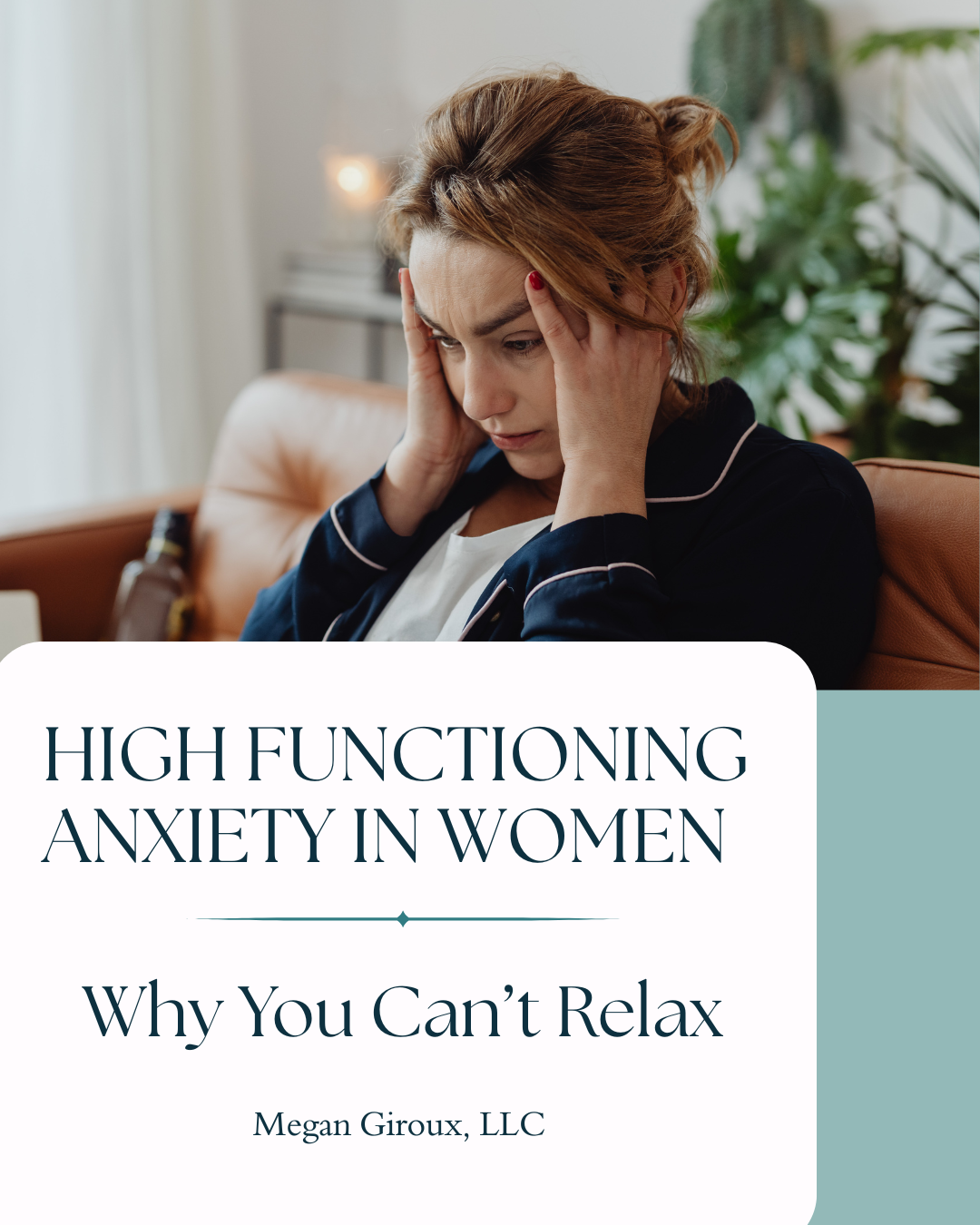
You finally have a moment.
The house is quieter. The work is done, or at least done enough. There is nothing urgent that needs your attention.
And yet, you cannot relax.
Instead of feeling relief, your mind starts scanning. You think about what you might be forgetting. What still needs to get done? What tomorrow will look like. What you could be doing right now to get ahead.
You may even try to sit down and rest, but it does not feel restful. It feels uncomfortable. Sometimes it even feels more stressful than just getting up and doing something.
If this sounds familiar, you are not alone.
This is one of the most common experiences I hear from women with high-functioning anxiety. If you are wondering how this fits into the bigger picture, you can read more about high-functioning anxiety in women and why it feels like you have to hold everything together.
Why Relaxing Feels So Difficult
For many women, the issue is not just being busy. It is what slowing down represents.
Relaxing often means that something is not getting done. It may mean that someone else has to step in. It may mean letting go of control over how something is handled.
That can feel risky.
There is often a belief that if you stop paying attention, things will fall apart. That something important will be missed. That your children, your work, or your relationships will suffer.
Even when nothing is actually wrong, your mind stays active as if it is preparing for something to go wrong.
This is not a lack of discipline or an inability to relax. It is a pattern that has been built over time.
The Mental Load That Never Turns Off
Many women carry a constant mental load that does not have a clear off switch.
You are thinking about schedules, responsibilities, conversations, and what needs to happen next. Even when you are not actively doing something, your mind is still working.
This is often what leads to that feeling of always being “on.”
You might notice:
Difficulty falling asleep because your mind is racing
Waking up already thinking about the day ahead
Replaying conversations or planning future ones
Feeling like you should be doing something even when you are resting
This ongoing mental activity makes it hard for your body to fully relax.
If you have ever wondered whether this is connected to anxiety, it often is. Many women do not initially recognize this as anxiety because they are still functioning and getting things done. If that resonates, you may want to read more about the signs of high-functioning anxiety in women.
The Fear of Dropping the Ball
Underneath the inability to relax is often a fear of what would happen if you did.
You may worry that:
Things will fall through the cracks
You will forget something important
Other people will not follow through
You will be seen as less capable
There is often a strong belief that you are the one holding everything together.
Because of that, relaxing can feel irresponsible.
Even if no one has said that directly, it can feel true internally. This belief keeps you in motion, even when you are exhausted.
When Your Identity Becomes “The Reliable One”
Over time, being the person who handles everything can become part of how you see yourself.
You are the one who shows up. The one who follows through. The one who makes sure everything gets done.
That identity can feel important. It can also feel hard to step away from.
If you were to slow down, ask for help, or let something be done differently, it might feel like you are not being who you are supposed to be.
This is one of the reasons relaxing feels uncomfortable. It is not just about rest. It is about identity.
Why Rest Can Feel More Stressful Than Doing
Many women tell me that when they try to rest, it does not feel relieving. It feels tense.
This is because your body and mind are used to operating at a high level of activity. Slowing down creates a contrast that can feel unfamiliar.
Rest may also bring up thoughts and feelings that are easier to avoid when you are busy. When you stop, there is more space to notice how overwhelmed, frustrated, or disconnected you might feel.
Because of that, staying busy can feel easier than sitting with what is underneath.
The Role of Overfunctioning
For many women, difficulty relaxing is closely connected to overfunctioning.
Overfunctioning is when you take on more than your share of responsibility in relationships and daily life. It can look like anticipating needs, solving problems for others, or doing things yourself because it feels easier than asking for help.
When you are overfunctioning, there is always something to do.
There is always something that could be handled better, faster, or more efficiently.
This keeps you in a constant state of action, which makes relaxation feel out of place.
Over time, this pattern can also lead to resentment. You may start to feel frustrated that you are carrying so much, even if you are the one who has taken it on.
If that feels familiar, you can read more about why resentment builds and what it is trying to tell you.
A Different Way to Think About Relaxing
Relaxing is not something you either can or cannot do. It is something that often needs to be relearned.
The goal is not to suddenly stop everything or force yourself to rest in a way that feels unnatural.
The first step is awareness.
Noticing when your mind is scanning for what is next. Noticing the urge to get up and do something. Noticing the discomfort that comes with slowing down.
From there, it becomes about understanding what is underneath that urge.
Is it fear that something will go wrong? Is it discomfort with not being productive? Is it a belief that your needs are less important?
As you begin to understand these patterns, it becomes easier to shift them in a way that feels more sustainable.
What’s Next…
If you struggle to relax, it does not mean you are doing something wrong.
It often means you have learned to stay in motion as a way to manage anxiety, responsibility, and expectations.
This pattern can work for a long time, but eventually it becomes exhausting.
The ability to relax is not about having less to do. It is about creating a different relationship with yourself and your responsibilities.
You do not have to keep operating at a pace that leaves you feeling overwhelmed and disconnected from your own life.

Author Bio
Megan Giroux, LCSW, is a Licensed Clinical Social Worker in Cary, NC, and the founder of Megan Giroux, LLC. She specializes in anxiety treatment for professional women using Cognitive Behavioral Therapy (CBT), Narrative Therapy, and Motivational Interviewing to help clients reduce overwhelm, strengthen boundaries, and reconnect with themselves. Megan provides in-person therapy at her Cary, NC office and is passionate about helping women move out of survival mode and into lives that feel sustainable and fulfilling.
Learn more about Megan and her counseling services in Cary, NC